
The Cost of Stuck in Survival

You’ve built the career. The family. The home. You’ve ticked the boxes. You’ve achieved what you set out to.
Yet if you’re honest — you’re tired. Not the kind of tired that sleep fixes. The kind that comes from holding everything together for too long.
It’s stuck in survival.
The Problem: Women Are Running on Empty
What This Feels Like
It’s waking up tired — before the day even begins — and wondering how you’ll get through the list again.
It’s sitting in meetings with your camera on and your light off.
It’s doing all the right things — yoga, supplements, self-care — and still feeling flat.
It’s snapping at your partner because you’ve run out of bandwidth, then carrying the guilt for the rest of the night.
It’s missing yourself — the version of you who used to laugh easily, dream bigger, rest without justification.
It’s the mental noise that never stops:
Did I send that email?
Did I book that appointment?
Am I doing enough?
Am I enough?
It’s being everyone’s go-to, while quietly wondering who’s there for you.
It’s the loneliness of high achievement — surrounded by people, yet unseen in your exhaustion.
Because from the outside, it still looks like you’re doing great.
The job. The family. The juggling act.
But inside, there’s a numb kind of ache — a mix of fatigue, resentment, and fear that this is all life will ever feel like.
It’s the dissonance between who you’ve become and what it’s costing you to stay that way.
And there might be silent, hidden tears, grief and fear because you’re wondering:
How long can I keep this up?
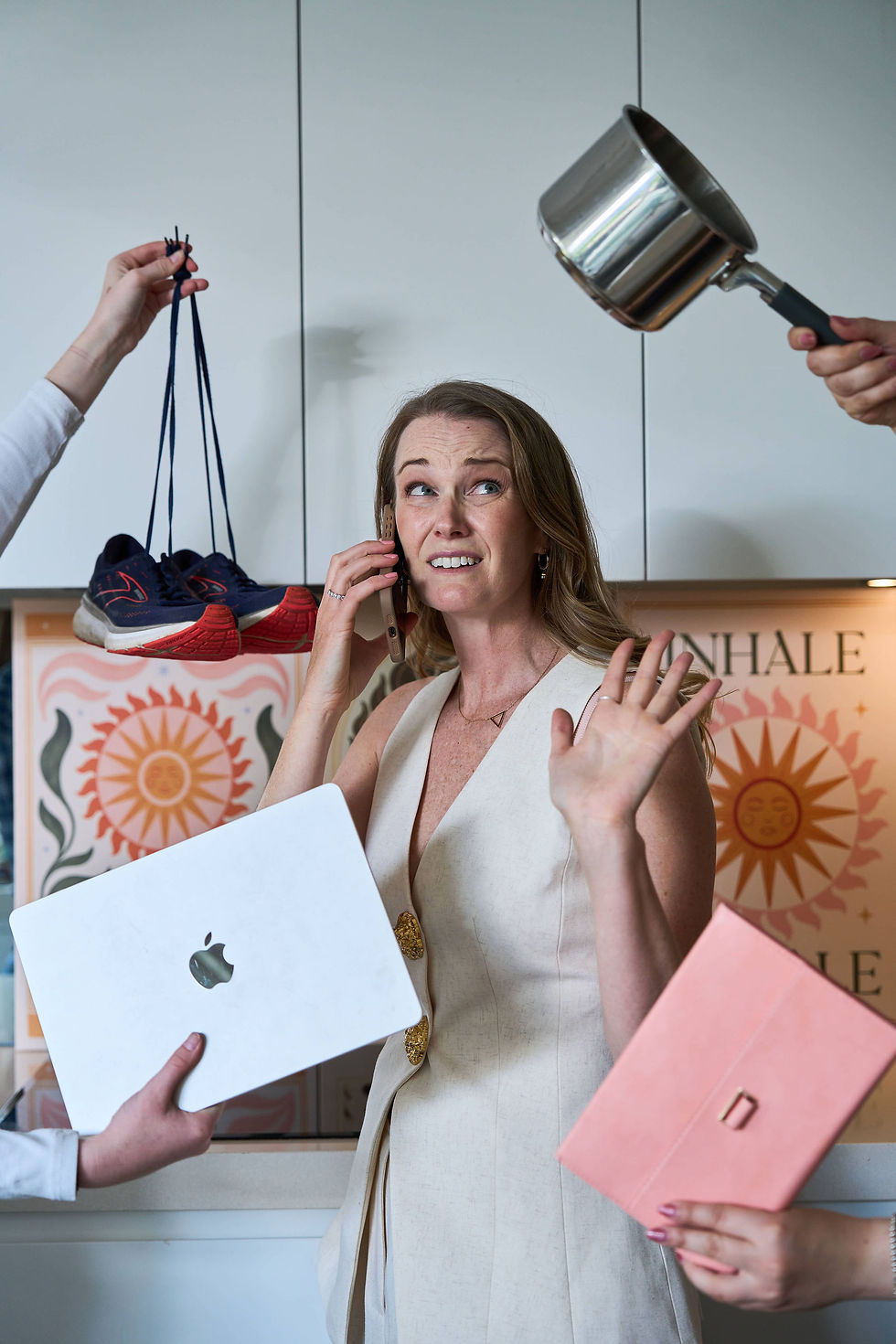
The research echoes this story. A recent study commissioned by Egon Zehnder, 2024 has women describing burnout in strikingly similar emotional language:
Exhausted but wired. The body’s still in go-mode, even when it’s begging to stop.
“I couldn’t sleep for more than three days. I was mentally and physically exhausted, but I couldn’t turn off my brain.” — Egon Zehnder, 2024
Disconnected but responsible. Present for everyone — but not really with anyone.
“I couldn’t articulate the feeling — because I was in it. And nothing was physically ‘broken’ for me to tell someone.” — Egon Zehnder, 2024
Grateful but resentful. You know you “should” be thankful for the life you built — yet the weight of invisible labour, family demands, and unrelenting pressure makes it feel like too much.
Successful but unfulfilled. The world sees achievement. You feel emptiness.
“On the outside, they appear calm, capable, and in control. Yet on the inside, the story can be very different.” — Egon Zehnder, 2024
If You're Feeling This You’re Far From Alone.
In Australia, nearly three-quarters of working mothers say they feel stressed juggling work and family commitments (National Working Families Survey, 2024).
Half of women are concerned or very concerned about their mental health, with stress rising year-on-year (Deloitte Women @ Work, 2024).
Globally, 42% of women report consistent burnout (McKinsey & Company and Lean In Women in the Workplace, 2021).
Only one in four workers feel engaged at work (Gallup State of the Global Workplace, 2024) — meaning 75% are “checked out.” Gallup calls it disengagement; in reality, it’s the body’s stress response — a nervous system stuck in maintenance mode, not growth.
46% of women want to leave their current employer within two years, driven by lack of balance, wellbeing and flexibility (Deloitte Women @ Work, 2024).
This doesn’t speak to ambition — it speaks to exhaustion. A workforce running from stress, not toward opportunity.
And while men are struggling too, working mothers are suffering at higher rates. Much of this stress comes from caring responsibilities outside of work (National Working Families Survey, 2024). The “invisible load” continues to fall largely to women — who still do around 50% more housework and nearly double the caring hours of men (ABS / HILDA).
Women are running on empty — exhausted, disconnected from themselves and sadly this trend is getting worse.
The Cost: What Survival Steals
Survival mode has a price — and it’s one too many women are quietly paying.
The cost isn’t just emotional. It’s physical, relational, and professional.
The Physical Cost
Working 55+ hours per week raises stroke risk by 35% and heart disease by 17% (World Health Organization).
Women aged 35–54 experience the highest rates of stress-related illness and fatigue (Australian Institute of Health and Welfare, 2023).
Mental health and substance-use disorders are the third-largest disease group contributing to the burden of disease for women, especially ages 25–44 (Australian Burden of Disease Study, 2024).
What this shows: Living in a constant state of “on” takes a physical toll. Chronic stress keeps cortisol high, the body in threat mode, and repair on hold. It interferes with hormones, reproductive health and immunity — leaving women more vulnerable to autoimmune disorders, diabetes and fatigue-related conditions.
The Relational Cost
Survival mode doesn’t just drain your energy — it reaches into the parts of life that matter most. Your relationships. With your partner, your children, the people you love most. The places that should feel safe start to feel strained. The moments where you crave connection and comfort turn into challenge and conflict.
Two-thirds of parents and carers highlight that work-family demands now significantly contribute to stress or tension in their relationships with partners, children, or dependents. This percentage has doubled since 2019, indicating a notable shift in the challenges faced by modern families. (National Working Families Report, 2024)
People with poor mental health are five times more likely to say it “often” affects their closest relationship (Relationships Australia, 2024).
42% of parents say stress and cost-of-living pressures affect their ability to be calm, loving partners or parents; 81% feel sleep-deprived weekly; 30% feel daily guilt about time with their children (Triple P National Parenting Survey, 2024).
Children whose mothers experience high psychological distress are more likely to develop social and emotional difficulties throughout childhood and adolescence (Australian Institute of Family Studies, 2024).
What this shows: When you’re in survival mode, connection becomes conditional on capacity — and capacity is often the first thing to go. The partner who once felt like a teammate starts to feel like another responsibility. Conversations turn into logistics. Affection becomes effort.
And the impact runs deeper. Children learn to regulate their emotions by co-regulating with the adults who care for them. When we’re stuck in survival — anxious, distracted, always holding it together — we’re not fully available to support them. So they build their own coping mechanisms to manage big feelings — ones not grounded in calm or safety. You can’t give calm when your body doesn’t feel safe — and it’s shaping the next generation.
The Organisational and Work Fulfilment Cost
Deloitte’s Women @ Work 2024 report found that half of women feel they can’t switch off from work — and 42% feel burned out most of the time.
Acute stress reduces creativity and cognitive flexibility, meaning new ideas, innovation, and strategic thinking are the first casualties when stress is high. (Thinking Skills and Creativity, ScienceDirect, 2024)
For women juggling work and home, the toll of chronic stress, poor sleep, and mental load can show up as lower productivity, higher absenteeism, and less fulfilment.
What this shows: When women can’t switch off, they don’t just lose rest — they lose creativity, innovation and clarity.
The parts of the brain that spark ideas can’t function when the body is flooded with stress hormones. This isn’t just a personal issue — it’s a performance issue for organisations, and a fulfilment issue for women.
The Greatest Hidden Cost: Your sense of YOU
It steals your joy. It steals your deep sense of contentment and peace. It steals your vibrancy.
It steals the quiet inner knowing and confidence that comes from knowing who you are when you’re not holding everything up.
That’s the real cost of survival mode — not just what it takes from your body, your relationships or your career, but what it takes from your sense of self.
What’s Driving It: How We Get Stuck in Survival Mode
We often point to the outside pressures — the workload, the deadlines, the constant demand to do more with less. Those pressures are real.
But what keeps many women stuck isn’t just what’s coming at them — it’s what’s been built into them.
Over years of proving, pleasing, and pushing, we’ve learnt to meet every expectation that comes our way. We don’t just work hard — we anticipate, over-deliver, and carry the emotional load for everyone around us.
So when the external pressures keep coming, our internal programming keeps saying yes.
Yes to one more project.
Yes to holding it all together.
Yes to keeping every ball in the air.
Even when our bodies and minds are quietly saying no. That’s how survival mode sustains itself — the world keeps asking, and we keep answering.
Let’s Look at What’s Going On: The Internal Patterns at Play
Even when we know we’re running on empty, these deeply ingrained patterns can keep us in motion. They’re our learned responses.
Here are a few, research shows are common, especially among women in performing in demanding roles.
Imposter Thoughts
75% of executive women have experienced imposter syndrome (KPMG Advancing the Future of Women in Business, 2024). It drives over-preparing, perfectionism, and overworking — an endless cycle of proving instead of being.
What this shows: Many high-achieving women aren’t fuelled by ambition alone, but by the need to validate their right to be where they are.
People-Pleasing and Approval Seeking
Women report higher rates of self-silencing and conflict avoidance at work (University of Melbourne, 2021). Chronic people-pleasing correlates with elevated cortisol and increased stress symptoms (Journal of Behavioral Medicine, 2019).
What this shows: Saying yes becomes a safety strategy. Declining feels like risk — of judgment, rejection, or loss of belonging.
Overachieving and Perfectionism as Protection
Socially prescribed perfectionism has risen 33% since the 1990s (Curran & Hill, 2019). Women in senior roles report a stronger need to prove themselves than in previous years (Deloitte Women @ Work, 2024). As author Ada Calhoun writes, Gen X became “the first generation told they could have it all — and the one most exhausted by trying.”
What this shows: When worth is tied to output, rest feels unsafe and “enough” never feels enough.
What You Can Do at an Individual Level
As I write this I find myself on one hand feeling quite bleak, and on the other like I have a fire burning bright in me that wants to help women find a new way.
I am not ignorant of the cost of living pressures that shape many of the decisions that we make. We live in a capitalist culture that rewards output over wellbeing. The demands of work — pace, performance, productivity — whatever your views on this version of society and our culture, they're here and they're real.
And yet, I still believe how we live within this system — how we show up in our families, within ourselves, and in the choices we make around work — is within our control.
We have agency. And that begins with responsibility — to lead yourself in a way that honours who you are and what you need so that you aren’t bearing the suffering and the high cost that we as women are facing today in the face of life’s demands.
A few tips
Start by noticing when you’ve slipped into survival mode: rushing, overcommitting, striving, holding it all together. That’s your cue to pause, not push. To ask, what am I trying to protect right now?
Research shows that chronic stress keeps cortisol high and the body in a constant state of alert — the nervous system can’t tell the difference between an urgent deadline and actual danger. To move out of survival mode, the stress has to leave the body.
Rest, breathwork, movement, time in nature, connection — they’re not indulgent; they’re essential. They signal to your system: you’re safe now.
From there, examine the rules you’re still living by — the ones that say: I have to prove my worth, keep everyone happy, hold it all together. Most of those beliefs were built for survival, not peace, not fulfilment.
You can choose new ones. Ones that make space for peace, joy, and work that feels aligned — not consuming.
There are many aspects from our external environment that we can’t control, but you can choose how you meet it.
A New Way Forward
If you’ve recognised yourself in this — I have deep compassion for where you're at. I have also been here. Please know you're not failing, your body and mind have been running a pattern that’s aimed at keeping you safe (and in all likelihood have been the patterns that have driven you to success).
That’s what my work helps women change.
Through my coaching, I support women to regulate their bodies, challenge outdated beliefs, and lead themselves differently — in life and business.
If you’re curious where to start, take my quiz to uncover which parts might be leading your life right now — the achiever, the caretaker, the perfectionist...
It’s a simple first step to create awareness and consider how you might move from stuck in survival to aligned in action.
Because you don’t need to do more — you need to do it differently.
Take care & much love.
Comments